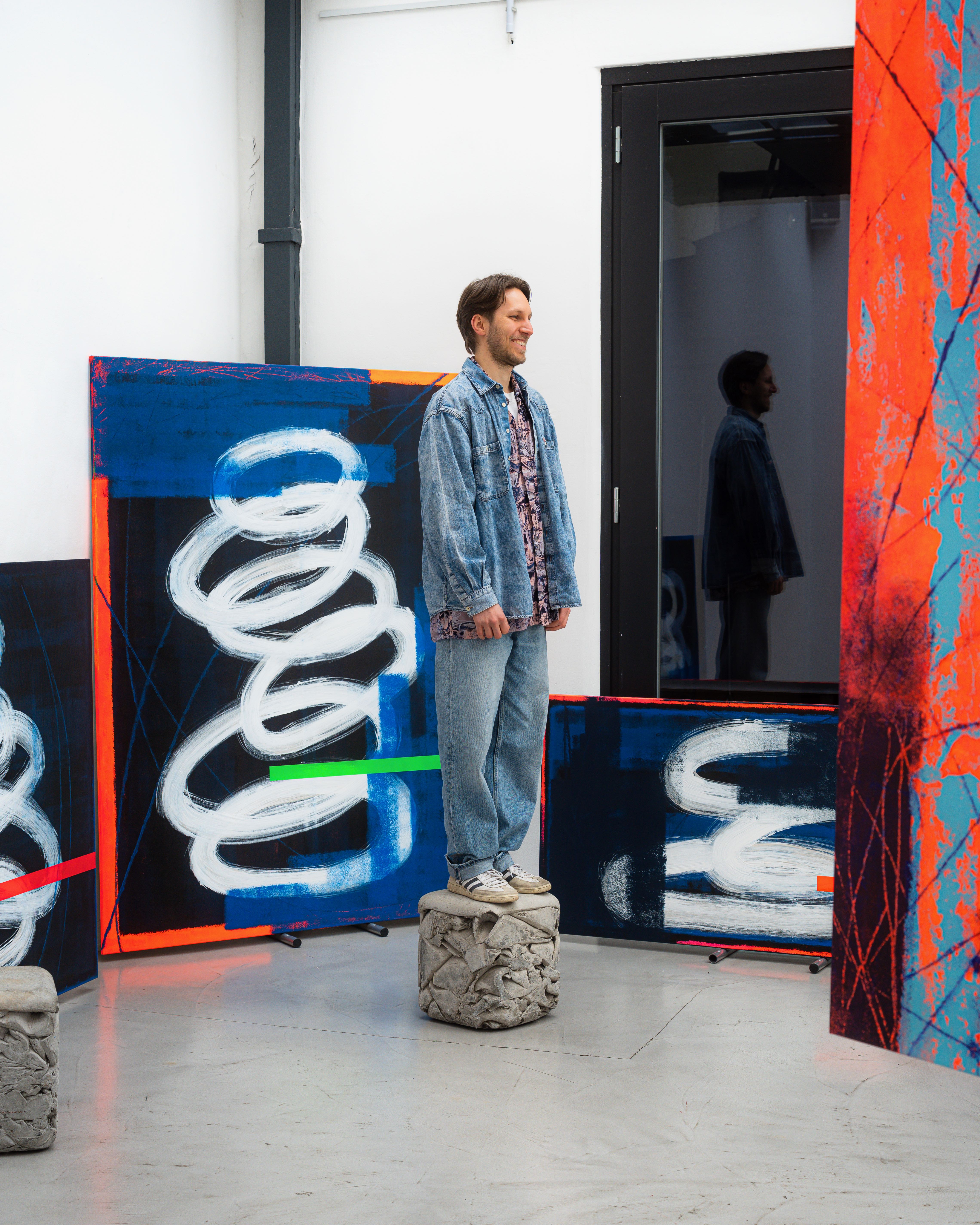
Nikolas Tichy, known under his artist name Nizen, did not arrive at art through academies or traditional artistic pathways. His background is rooted in technology and entrepreneurship. Today, he merges artistic expression with strategic thinking, positioning himself not only as a painter but as a founder and connector within the creative economy.
We spoke about visibility, risk, collaboration, digital tools and the meaning of home.
Alena: We previously featured you as a newcomer. Today you are far from that. You are an established artist and the founder of your own platform. When did that shift happen?
NIZEN: I have always seen myself as an entrepreneur first. I started my first company when I was eighteen or nineteen. My background is in IT. I am a trained IT engineer and apart from one or two employed positions I have mostly been self employed with agencies and startups. Art was not the beginning of my professional life. It became part of it later. Once I decided to take it seriously, I approached it with the same mindset I bring to any venture. I built structure around it.
Alena: Your path into art was not linear. How did it begin?
NIZEN: It started intuitively. Around 2015, after visiting a museum, I remember thinking that I could try something like this myself. That curiosity led me to begin painting without pressure or expectation. Creativity has always existed in my family. My grandmother painted and many relatives are skilled at drawing. For me, art was initially exploration rather than a career decision.
The true turning point came when I decided to make my work public.
Alena: Was making your work visible the most difficult step?
NIZEN: Yes. I believe the biggest step for any artist is publishing their work. There are many talented people who hesitate to share what they create. The fear that someone might not like it can be paralyzing. Once you move past that, something changes. You realize that in a world of billions of people there will always be someone who connects with what you create.
In 2023 I launched my Instagram account under the name Nizen. I treated it almost like launching a company.
Alena: You describe yourself as an entrepreneur. How does that influence your artistic practice?
NIZEN: I see art as something that can be structured like a company. If you want sustainability, you need positioning, sales and clarity. That does not make the work less authentic. It means you take it seriously enough to build a system around it. In the beginning I did not live exclusively from art. I continued working on other projects to ensure financial stability. In 2025 I made the decision to focus entirely on art and on my platform. That gave me mental clarity. When you remove distractions, your creativity becomes more focused.
Alena: How did the artist name Nizen come about?
NIZEN: It is a combination of Niki and Zen. I am not a practicing Buddhist, but I am inspired by Zen philosophy and its emphasis on calm and reduction.
The name felt right immediately. I did not overanalyze it.
Alena: Your work feels urban yet meditative. Where do those influences originate?
NIZEN: I grew up in Vienna in a municipal housing environment surrounded by concrete and structure. Street art was part of the visual language around me. That urban influence is still present in my work through geometric forms and architectural compositions. At the same time I am drawn to calmness and reduction. The Zen element represents stillness and balance. My art brings those two forces together, the city and silence.
Alena: You openly embrace collaborations with brands, something that is sometimes viewed critically in the art world. Why?
NIZEN: I genuinely enjoy collaborations. For me it is about two strong identities meeting. When done thoughtfully both sides benefit. I have always been proactive in reaching out to brands that resonate with me. Some decline and some say yes. That is part of the process. One example was a limited edition bottle design for an Austrian beverage brand. Seeing my artwork on a product in everyday retail was a powerful experience.
Alena: You also founded Vollzeit. What is the idea behind it?
NIZEN: Vollzeit developed from a practical situation. I received more collaboration requests than I could accept myself. It felt wrong to simply turn them down. So I created a platform where artists and companies can connect. I do not teach artists how to be artists. I connect them with brands, hotels, retailers or institutions that want to realize creative projects. We curate talent, host open calls and facilitate collaborations. The goal is to create opportunities that might otherwise not happen.
Alena: How do you approach digital art and artificial intelligence?
NIZEN: I regularly use digital tools, especially for sketching and testing compositions. They are efficient and allow flexibility. Regarding artificial intelligence, I have not integrated it deeply into my artistic process yet. I am not opposed to it in principle. If someone approaches it with intention and a clear concept, it can be a tool. Ultimately it depends on how it is used.
Alena: What role does your own home play in your creative life?
NIZEN:I live in Vienna in the third district in a renovated attic apartment with high ceilings and a terrace. It combines the charm of an older building with modern light and openness. My studio is part of my home. I have considered renting a separate atelier but I feel most creative in my own space. Over time I have become more attentive to quality in furniture and materials. Perhaps that comes with age or with becoming more aware through art.
Alena: Do you need chaos or order to create?
NIZEN: Order. Without question. There is a common stereotype that creative people thrive in chaos. For me it is the opposite. The space must be clear so that ideas can flow freely.
Alena: What does home mean to you today?
NIZEN: Home is both retreat and workspace. Ideas often emerge outside in the city or in movement. At home they take form. When you feel comfortable in your environment your creativity becomes more focused and grounded.
Alena: How would you describe your art in one sentence?
NIZEN: Urban structure meets meditative calm.